
There is no single perfect month for every China trip. The best time to visit China depends on what kind of experience you want, which regions you plan to include, and how much you care about factors such as heat, rain, crowds, snow, or autumn color. A first-time visitor focusing on Beijing, Xi’an, Shanghai, and Guilin may make different choices from a repeat traveler heading to Yunnan, Tibet, Zhangjiajie, or Harbin.
In broad terms, spring and autumn are usually the easiest seasons for most travelers. They tend to offer more comfortable temperatures, better walking conditions, and a wider range of destinations that feel pleasant rather than extreme. Summer can still work well, especially for mountains, grasslands, and high-altitude areas, but it is often hotter, wetter, and busier. Winter is more specialized: excellent for snow scenery, fewer crowds in some cities, and lower prices in certain periods, but less comfortable if your trip relies on long outdoor sightseeing days.
The key is not to search for one universal answer, but to match the season to your route. China is too large for one weather pattern to describe the whole country, so smart planning starts with understanding both the season and the region.
Why Timing Matters More in China Than in Smaller Destinations
China covers a wide geographic range, which means travel conditions can change dramatically from one region to another. In the same month, you might see warm spring weather in South China, comfortable sightseeing conditions in the east, and lingering cold or even snow in parts of the north or west. That range is one reason timing matters so much when you are building a route.
Seasonal timing also affects more than temperature. Visibility, humidity, autumn foliage, spring blossoms, holiday crowds, and domestic travel peaks all shape the experience. A destination may still be open year-round, but the difference between an easy, photogenic trip and a tiring one often comes down to timing rather than attraction quality.
Spring in China: One of the Safest Choices for Most Travelers
Spring, especially from April to May, is often one of the safest answers to the question of the best time to visit China. Temperatures are usually milder, landscapes begin to turn green, and many classic sightseeing cities become more comfortable after winter. For travelers who want a broad first trip rather than a highly specialized one, spring is one of the easiest seasons to work with.
This is a particularly good time for destinations such as Beijing, Xi’an, Shanghai, Guilin, Chengdu, and Zhangjiajie. Walking days are usually more manageable than in the height of summer, and the overall travel rhythm often feels smoother. In some places, spring also brings blossom scenery and softer light for photography.
The main trade-off is that spring weather is not always stable. Rain can appear in some southern areas, and early spring can still feel cool in the north. Even so, for many travelers, the balance of comfort, scenery, and route flexibility makes spring one of the strongest seasons overall.

Summer in China: Best for Mountains, Nature, and School-Holiday Travel
Summer is not the easiest season everywhere, but it is far from a bad time to visit China. It often works best when the trip is built around places that benefit from greener scenery, cooler elevation, or outdoor nature experiences. If your route includes Yunnan, Tibet, parts of Sichuan, Guizhou, Inner Mongolia, or other higher or cooler regions, summer can be a strong choice.
The challenge is that many major cities become hot, humid, and more tiring for full-day sightseeing. Rainfall also becomes more relevant in some regions, especially in the south. Families traveling during school holidays may still choose this season because of scheduling, but they usually need a smarter route rather than a city-heavy one.
In practical terms, summer is best approached selectively. It is often better for mountain landscapes, grasslands, and scenic trips than for a classic urban route packed with long outdoor sightseeing sessions.

Autumn in China: The Most Balanced Season for First-Time Visitors
Autumn, especially from late September through November, is often the most broadly appealing season for a China trip. For many travelers, this is the closest thing to a high-confidence answer to the best season to visit China. Temperatures are usually more comfortable, the air can feel clearer in many regions, and the scenery becomes richer as foliage changes in mountain and countryside destinations.
This is an excellent time for first-time visitors who want classic highlights without the summer heat, and for repeat travelers who want hiking weather, autumn color, and better photography conditions. Cities such as Beijing and Xi’an often feel easier in autumn, while destinations such as Zhangjiajie, Jiuzhaigou, and parts of Yunnan become especially attractive.
The main caution is early October, when the National Day holiday period, often called Golden Week, can make transport and major attractions busier and more expensive. The month itself remains strong, but timing within the month matters.

Winter in China: Best for Snow, Fewer Crowds, and Specialized Trips
Winter is usually not the default choice for a broad first-time China trip, but it can be excellent for the right traveler. If you want snow scenery, winter festivals, fewer crowds in some cities, or lower prices outside holiday peaks, the season has real strengths. It is especially good for Harbin, Northeast China, winter-themed experiences, and selected cultural cities when you do not mind the cold.
Winter can also work for travelers who prefer atmosphere over convenience. Historic sites may feel calmer, and some destinations look striking under clear skies or light snow. On the other hand, long outdoor days become harder in colder regions, and certain nature-based routes feel less comfortable than they do in spring or autumn.
In short, winter is best treated as a deliberate choice rather than a general recommendation. It suits travelers who want a particular mood or seasonal experience, not necessarily the easiest all-round conditions.

Best Time to Visit China by Travel Style
If you are planning a first trip focused on classic cities and headline attractions, spring and autumn are usually the most reliable choices. They make it easier to combine Beijing, Xi’an, Shanghai, Guilin, and Chengdu without too much discomfort from extreme heat or winter cold.
If your priority is natural scenery, mountains, and photography, the answer depends more on the destination. Summer can be excellent for highland and mountain areas, while autumn is often stronger for broader landscape travel, especially where clearer skies and foliage matter. For snow and winter atmosphere, the colder months become the obvious choice.
If you are traveling as a family, shoulder seasons often work best because they reduce weather stress and make sightseeing days easier. If you have to travel during school holidays, route design becomes more important than the calendar itself. Choosing the right region can matter more than trying to force a one-size-fits-all season.
When to Be More Careful With Timing
The strongest caution point in the calendar is the National Day holiday period in early October. This can bring heavier domestic travel demand, higher prices, fuller transport, and busier major attractions. October remains one of the strongest months overall, but it usually works better after the first holiday week.
High summer also needs more careful route planning. This does not mean you should avoid China in summer, but it does mean some city-heavy itineraries can feel more tiring than travelers expect. In the rainy season, southern and subtropical destinations may require more flexibility as well.
Winter holiday periods can also reshape the travel experience. A winter trip may feel quiet and good value in one part of the season, then become far busier around festival travel peaks. For overview planning, it is always worth checking both the season and the holiday calendar together.
Best Places by Season: A Simple Planning Shortcut
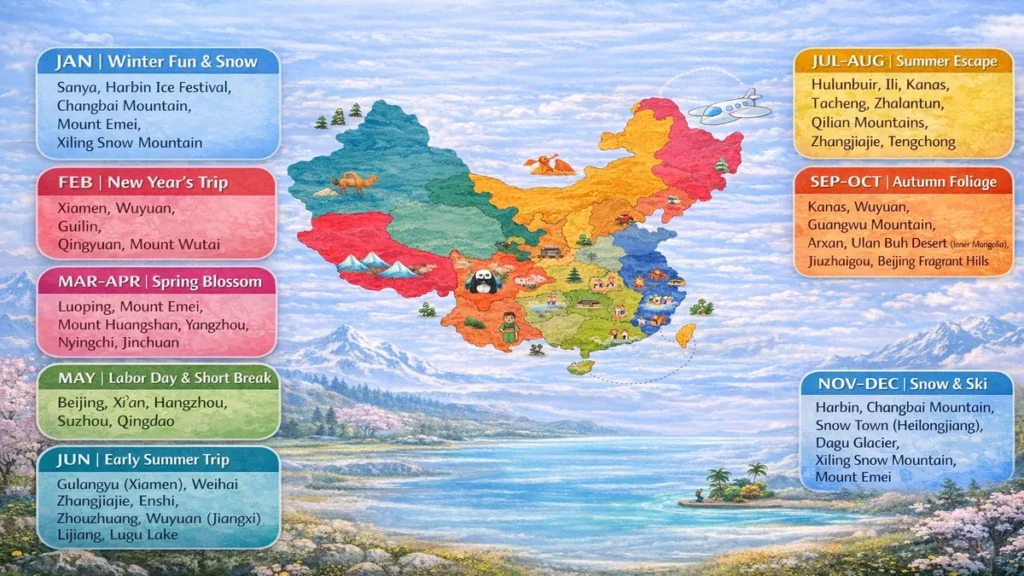
For spring, think of broad classic routes and mixed scenery: Beijing, Xi’an, Shanghai, Guilin, Chengdu, and Zhangjiajie. For summer, think of places that handle heat better or shine in green season: Yunnan, Tibet, parts of Sichuan, Guizhou, and grassland routes. For autumn, think of classic first-trip cities plus foliage and hiking destinations such as Beijing, Jiuzhaigou, Zhangjiajie, and Yunnan. For winter, think of Harbin, Northeast China, and selected city or cultural routes where snow or lower-season calm is part of the appeal.
This kind of seasonal grouping is useful because it turns a very broad question into a more practical one. Instead of asking for one best month for the whole country, you start asking which destinations are strongest in the season you can actually travel. That approach usually produces a better itinerary.
So, What Is the Best Time to Visit China?
For most travelers, the best time to visit China is spring or autumn. If you want the broadest mix of comfortable weather, classic sightseeing conditions, and route flexibility, these are usually the strongest seasons. They are especially reliable for first-time visitors building a multi-city itinerary.
If you can only travel in summer or winter, the answer is not to force the same route you would take in April or October. Instead, choose destinations that perform well in those conditions. China rewards seasonal planning, and the best trips usually come from matching the month to the right region rather than chasing a single generic answer.