
Planning a trip to China can feel exciting, but also a little overwhelming. The country is large, travel distances are long, and the number of possible routes can easily push first-time visitors toward over-planning. A good China itinerary is not about fitting in as many cities as possible. It is about matching the route to your travel style, trip length, and priorities.
Some travelers want a classic first trip built around Beijing, Xi’an, and Shanghai. Others want to combine iconic cities with scenery, food, or slower cultural stops. That is why the best China itinerary does not begin with a fixed list of cities. It begins with a simple question: what kind of trip are you actually trying to create?
How to Start Planning a China Itinerary
The first step in building a China travel itinerary is not choosing cities. It is choosing the kind of experience you want. Some travelers want a landmark-focused first trip; others want a more scenic route with mountains, rivers, or smaller cultural stops. Families may care more about pace and convenience, while repeat visitors may prefer more distinctive combinations.
In practice, most China itineraries fall into four broad patterns: classic first-time routes, city-and-culture routes, scenic routes, or mixed itineraries that combine urban highlights with nature. The mistake many travelers make is trying to build all four into one trip. China usually rewards focus more than speed.
How Many Days Do You Need in China?
For most international travelers, 7 to 14 days is the most practical range. A shorter trip can still work, but it needs tighter focus. A longer trip gives you room to combine famous cities with a more scenic or regional experience.
A 7 day China itinerary is usually best for a short introduction with two or three destinations. A 10 day China itinerary is often the most flexible option because it can support three or four stops without feeling too compressed. A longer trip of around two weeks or a little more gives you the best chance to combine classic cities with one stronger scenery-based destination.
What Makes a Good China Itinerary?
A strong route usually has three qualities: logical geography, manageable pacing, and a clear travel theme. Logical geography means avoiding unnecessary backtracking. Manageable pacing means understanding that flights, trains, station transfers, and hotel changes all affect how much energy you still have for sightseeing.
A clear travel theme matters because not every traveler wants the same China. A family route, a landscape route, and a classic first-time route should not all be built in exactly the same way. The best China itinerary is not the one that includes the most places. It is the one that fits the traveler best.
Best China Itinerary for First-Time Visitors
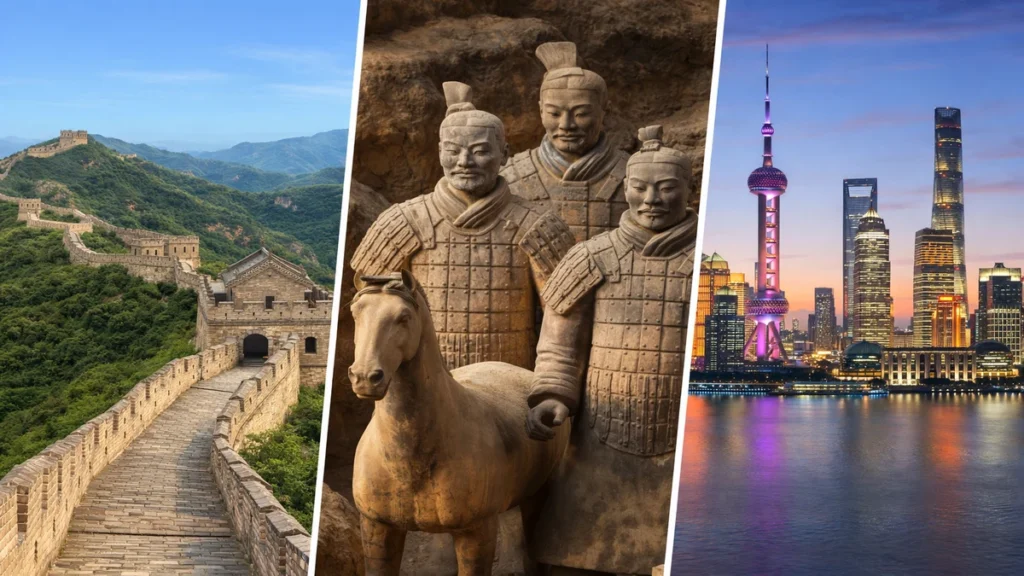
For many first-time visitors, the classic Beijing, Xi’an, and Shanghai combination remains one of the strongest foundations. Beijing gives you imperial landmarks and the Great Wall, Xi’an adds ancient history and the Terracotta Army, and Shanghai brings in modern China and a more contemporary city rhythm.
This route works well because the cities balance each other. It creates a broad first impression of China without requiring a highly specialized interest. At the same time, it should not be treated as the only valid first trip. Travelers who care more about scenery, food, or slower cultural destinations may want to replace one city with another stop.
Short China Itineraries: Around 7 Days
A short China itinerary usually works best with two or three destinations. At this length, the goal is not to cover as many famous places as possible, but to build a route that feels clear and manageable. This is why short trips are better treated as overview or planning concepts rather than fixed multi-city product structures.
For many travelers, Beijing plus Xi’an is a strong 7-day combination if history is the priority. Beijing plus Shanghai works better for those who want an easier contrast between imperial and modern China. A faster Beijing-Xi’an-Shanghai structure is possible, but the pace will be tighter and should be presented as a broad introduction rather than a relaxed itinerary.
10 Day China Itineraries
A 10 day China itinerary is often the most flexible option because it allows travelers to combine three or four destinations without making the trip feel too rushed. In practice, this type of route works especially well when classic cities are paired with one scenic or cultural stop.
That structure aligns well with routes such as Beijing, Guilin, Shanghai, and Xi’an; Beijing, Shanghai, Xi’an, and Zhangjiajie; Beijing, Hangzhou, Shanghai, and Xi’an; or Beijing, Hangzhou, Shanghai, and Suzhou. The common logic is not that every traveler should follow the same sequence, but that 10 days often gives enough space to combine iconic cities with one softer regional layer.

Longer China Itineraries: 2 Weeks and Beyond
Longer China itineraries give travelers more room to combine classic cities with deeper regional experiences. In practice, routes of around two weeks or a little longer often work better for combining destinations such as Beijing, Chengdu, Xi’an, and Zhangjiajie without making the pace feel too compressed.
This kind of structure is useful for travelers who want more than a landmark checklist. It allows time for food, nature, and route depth, rather than relying only on headline cities. Even if the page title uses ‘7, 10, or 14 days’ for search clarity, the overview logic here should stay flexible enough to support two-week-plus planning where needed.

How to Choose the Right Cities for Your Route
Choosing cities for a China itinerary should always come back to traveler priorities. If you want history, Beijing and Xi’an are difficult to replace. If you want modern city energy, Shanghai makes sense. If you want landscapes, places such as Guilin or Zhangjiajie can add a very different layer. If you want a more elegant east-China route, Hangzhou and Suzhou work well alongside Shanghai.
This is why many good China itineraries are really city-and-scenery combinations rather than city-only lists. A route feels stronger when it has contrast: heritage plus skyline, food plus nature, or classic icons plus slower local atmosphere.
Common Mistakes When Planning a China Itinerary
One common mistake is trying to see too much. China is not a destination where adding more cities automatically creates a better trip. Every extra stop changes the pace of the whole itinerary.
Another mistake is treating all destinations as equally necessary. In reality, some places are core priorities for some travelers and optional for others. A family with children, a food-focused couple, and a landscape photographer should not all be given the same structure. A third mistake is ignoring arrival and departure logistics. Good route planning is not only about attractions. It is also about how the trip actually feels from day to day.
Should You Build a Private or Customized China Itinerary?
For travelers with specific interests, limited time, or family needs, a customized itinerary often works better than a generic route. China is the kind of destination where small adjustments in geography, pacing, and city choice can make a big difference.
A private or tailored China itinerary is especially useful if you are traveling with children, older relatives, or a clear trip theme in mind. It can also help if you want to combine classic landmarks with a less standard scenic destination, because those routes often need more careful timing.