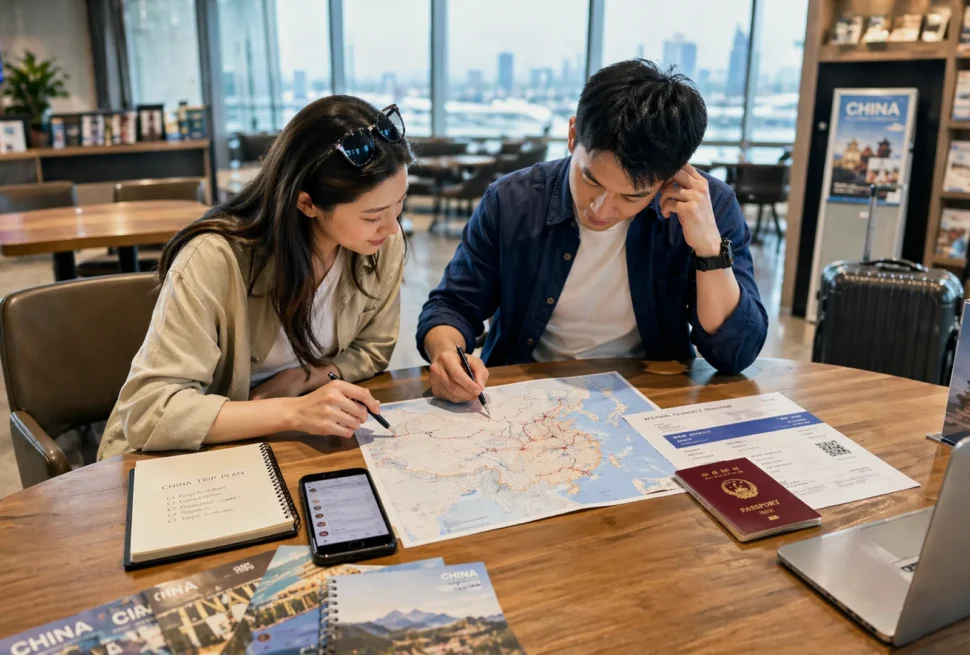
A smoother trip to China usually depends less on sightseeing and more on preparation. For many first-time visitors, the real difficulties are not famous landmarks or long distances, but the everyday details: how to pay, what works online, how to get around without Chinese, what to drink, what to pack, and how much friction to expect in ordinary situations. Once those basics are understood, China becomes much easier to travel through than many visitors expect.
One useful way to think about China travel is that it is highly digital, highly urban, and often easier in practice than it looks from outside. The biggest mistakes usually happen when travelers arrive assuming that cash, Google services, verbal English communication, and spontaneous on-the-spot problem solving will carry the whole trip. In reality, the smoother approach is to prepare the right apps, test payment tools early, pack lightly, and build a route that matches the weather and your own pace.
On this page
Set Up Payments Before the Trip
Digital payment is one of the most important parts of practical travel in China. Alipay and WeChat Pay are the systems that matter most for daily use, and for many travelers at least one of them is necessary for independent movement. Small restaurants, markets, transport services, convenience stores, and many everyday vendors rely heavily on QR-code payment. International credit cards alone are often not enough for smooth daily spending.
For most short-term visitors, Alipay is the easier first choice. It supports international cards directly, offers an English-friendly interface, and is generally the more straightforward setup for foreigners. WeChat Pay is also useful, but it tends to be more complicated for short-term visitors because setup can be less predictable and limits may be lower at the beginning. A practical approach is to make Alipay your primary payment method, keep one international credit card as backup, and carry a small amount of RMB cash for emergencies rather than depending on cash for normal daily use.
The most important payment habit is to test everything early. If Alipay or WeChat Pay is linked but never tested, the first failure usually happens at the worst moment: dinner, train tickets, a ride, or a small shop with no practical alternative. It is much better to test a small purchase on day one while you still have airport Wi-Fi, hotel support, and time to fix the problem.
Prepare for a Different Internet Environment
A second major adjustment is internet access. Google, WhatsApp, Instagram, and many familiar Western platforms do not work normally in mainland China. That includes Google Search, Google Maps, Gmail, Facebook, Instagram, and often encrypted messaging tools. Travelers who assume their normal digital habits will continue unchanged often lose time and confidence during the first days of the trip.
The practical solution is not to fight the system in the middle of the trip, but to prepare different tools. WeChat becomes important not only for messaging, but also for business contact, service communication, and mini-app functions. Baidu Maps or Amap matter more than Google Maps for navigation. Alipay matters not only for payment, but also as part of the wider digital travel ecosystem. Travelers who prepare those platforms in advance usually adapt much faster than those trying to recreate their home-country setup.
This is also why downloading key apps before arrival matters. A practical pre-trip setup includes WeChat, Alipay, Baidu Maps, a ride-sharing app such as Didi, and an offline translation tool. If important addresses, confirmations, or identity information are only stored in blocked services, small routine tasks can become unnecessarily difficult.
Do Not Overestimate the Language Barrier
Not speaking Chinese is usually less of a problem than first-time visitors expect. In major cities and major transport systems, English signage is common enough to make metro travel, train travel, airport navigation, and hotel routines manageable. Major attractions, large hotels, and many tourist-facing services also provide enough English support for basic travel needs. Chinese language ability improves the experience, but it is not required for a comfortable short trip in the main travel corridor.
The real solution is not memorizing many phrases. It is using the right tools well. An offline translation app is usually the most effective first tool. Camera translation helps with menus and signs, text translation helps with hotel or restaurant communication, and simple display-on-screen communication is often faster than trying to speak. For daily travel situations such as ordering food, showing an address, asking for help, or clarifying a transport question, phones usually solve the language gap more efficiently than spoken English alone.
That said, language barriers do still increase outside the major travel circuit. Secondary cities, small towns, and remote scenic areas usually offer less English signage and less English-speaking staff. If your route moves beyond Beijing, Shanghai, Xi’an, Chengdu, Guilin, and similar mainstream destinations, you should rely more heavily on maps, screenshots, hotel address cards, and translation tools rather than expecting easy verbal interaction everywhere.
Use Apps to Reduce Friction in Transportation
Transportation becomes much easier when it is app-led rather than conversation-led. Didi is especially useful because it removes the need to explain destinations to taxi drivers and reduces the risk of confusion about route or fare. Baidu Maps helps with public transport planning, while Alipay and WeChat integrate with many transport and ticketing functions. In practical terms, using apps is often the difference between a smooth day and a tiring one.
For public transportation, major metro systems in cities such as Beijing, Shanghai, Chengdu, Xi’an, and Hangzhou are manageable for non-Chinese speakers. English station signage is common in major systems, route planning can be done through Baidu Maps, and metro payment can often be handled digitally. High-speed train travel is also workable without Chinese if booking and directions are handled in advance. Major stations often have bilingual signage, and the combination of app booking, station signs, and ticket checks is usually enough for straightforward intercity travel.
The most useful principle is simple: avoid unnecessary improvisation. Book key train or flight segments in advance, keep hotel addresses saved in Chinese, and rely on mapped routes rather than casual street-level trial and error. In China, digital preparation often matters more than verbal confidence.
Essential Apps for a Smoother Trip
The right apps usually make daily travel in China much easier, especially for payment, navigation, ride-hailing, and basic communication.
Alipay
Useful as the main payment tool for many short-term visitors.
WeChat
Important for messaging, service communication, and parts of the wider digital travel ecosystem.
Baidu Maps or Amap
More useful than Google Maps for local navigation.
Didi
Useful for app-based transportation and reducing communication friction.
Offline Translation Tool
Helpful for menus, signs, addresses, and daily communication.
Food and Water Require Adjustment, Not Fear
Food and water concerns are common, but they are usually manageable with ordinary precautions. Tap water in mainland China is not recommended for direct drinking. Bottled water is inexpensive and widely available, restaurants commonly provide tea or boiled water, and many hotels provide bottled water in the room. For most travelers, the practical rule is straightforward: do not drink cold tap water directly, but do not worry about normal use such as bathing or brushing teeth.
Food safety has improved significantly in major cities, and established restaurants are generally safe. Busy food stalls often work better than empty ones because turnover is faster and food is fresher. What many travelers interpret as “food poisoning” is often just digestive adjustment during the first few days of the trip. That kind of stomach discomfort is common and usually temporary, especially when the diet changes quickly. Hydration, gradual adjustment, and not overloading on unfamiliar dishes on day one are often more useful than trying to avoid local food entirely.
Travelers with special dietary needs should prepare more actively. Translation cards for allergies, vegetarian needs, halal requests, or other dietary restrictions can reduce friction substantially. In major cities, restaurants are often able to accommodate requests when the need is clearly shown, even if direct spoken conversation is limited.
Pack Light, but Pack the Right Things
Overpacking is one of the easiest ways to make a China trip harder than it needs to be. China is urbanized, shopping is easy in most places, and common toiletries or basic travel items can usually be replaced during the trip. Carrying too much luggage creates more stress on flights, trains, and hotel changes than it saves in preparation. A lighter bag usually means faster movement, easier station navigation, and fewer daily decisions.
What matters most is not bringing everything, but bringing the things that are harder to replace well. Comfortable walking shoes matter. Layers matter because weather can vary sharply by region and time of day. Medications matter because equivalent products may be harder to identify quickly. Digital tools matter because your phone becomes part payment system, part map, part translation device, part booking wallet, and part daily problem-solver.
Electronics deserve particular attention. China uses 220V power, so travelers should check their chargers and bring a suitable converter where needed. A portable battery pack is extremely useful because maps, translations, mobile payment, ride-hailing, and travel confirmations all depend on phone battery life. A dead phone in China is often more disruptive than forgotten clothing.
Safety Is Usually Strong, but Practical Awareness Still Matters
For most ordinary travelers, China is generally experienced as a safe destination. The main safety issues described in the source materials are not street violence or serious tourist targeting, but lower-level risks such as unlicensed taxis, occasional overcharging, ordinary luggage loss, seasonal air quality concerns, and altitude adjustment in highland regions. In everyday terms, this means most trips benefit more from basic awareness than from anxiety.
That does not mean travelers should become careless. Using official or app-based transport, avoiding empty areas late at night in unfamiliar districts, carrying copies of important documents, and keeping medical basics on hand are all sensible habits. Families, solo travelers, and older travelers generally move through the main China travel circuit without unusual safety concerns, but practical habits still improve comfort.
Health-related preparation is also part of safety. Bottled water is the standard choice for drinking, basic stomach adjustment is common in the first days, and travelers to high-altitude regions should treat altitude seriously rather than casually. Travel insurance with medical coverage is also a practical layer of preparation rather than an unnecessary extra.
Budget Becomes Easier to Control When the Trip Is Structured Well
China can work across very different budgets, but total cost depends heavily on route design, hotel level, transport choices, and whether the trip is independent or organized. The source material describes a wide range, from budget travel to mid-range and luxury, with major cost differences driven by flights, accommodation level, food style, and season. Intercity trains often provide better value than flights on mid-range routes, and mid-range hotels in China can offer strong value compared with equivalents in many Western cities.
For practical trip planning, the most important budget lesson is not just “China can be expensive or affordable.” It is that the route determines the spending pattern. A route with too many internal flights, too many city changes, or peak-season hotel pressure can make a trip feel disproportionately expensive. A better-paced route, with stronger use of rail and a more focused destination mix, often controls both cost and stress at the same time.
The Smoothest Trips Usually Share the Same Habits
The travelers who usually have the easiest China trips tend to do the same things early. They set up payment before departure or immediately on arrival. They download translation, maps, and transport apps before they need them. They carry less but pack more intelligently. They do not depend on Google services for local navigation. They do not assume cash will solve digital payment gaps. They save hotel addresses, keep their phone charged, and learn the basic structure of how movement works from airport to hotel to station to attraction.
That is also why China often feels hardest at the beginning and easier after the first two or three days. Once payment works, maps are familiar, translation apps are tested, and the first few meals and rides are done successfully, the country becomes much more readable. Most travel friction is front-loaded. Good preparation reduces that first layer of difficulty and makes the rest of the trip more enjoyable.
Final Notes for Travelers
A smoother China trip usually comes down to a few practical priorities: prepare digital payment before you need it, expect a different internet environment, rely on maps and translation tools rather than spoken English alone, pack for mobility rather than excess, drink bottled or boiled water, and keep your route realistic in cost and pace. China rewards preparation more than improvisation, and once the basic systems are in place, daily travel usually becomes much easier.