Taking a train in China for the first time is usually easier than many travelers expect. The system is fast, widespread, and highly practical, but the first trip can still go wrong in very ordinary ways: booking the wrong train type, going to the wrong station, arriving too late, misreading the station name, or bringing luggage that becomes a problem at security. The real challenge is rarely the train ride itself. It is understanding the decision points before boarding.
The easiest way to approach China train travel is to think in sequence: choose the right train, book it correctly, read the information clearly, arrive at the station with enough time, and know what happens between the station entrance and your seat. Once that logic is clear, the whole experience becomes much more manageable.
Quick Answer
- Choose the right train type for your route.
- Check the exact station name, not just the city.
- Book with the correct passport details.
- Arrive earlier than you think you need to.
- Keep luggage manageable and follow the station process calmly.
Start With the Right Question: Is Train the Right Choice for This Trip?
For a first-time traveler, the most useful question is not “How do I book a ticket?” but “Should I take a train for this route at all?”
If you are traveling between major cities with strong high-speed rail connections, the train is often one of the simplest options. On many classic travel corridors, high-speed rail is not only convenient but also easier to handle than an airport transfer because the boarding process is more straightforward.
If your route is short to medium in distance, high-speed rail is often the most practical choice. If your route is between neighboring cities, especially within the same region, train travel becomes even more attractive because it reduces airport friction and keeps the day moving more smoothly. C-series trains are especially relevant for these shorter intercity links.
But not every route should be treated the same way. Some destinations are served by high-speed trains, some by slower trains, and some still rely more heavily on conventional rail. That matters because first-time travelers often assume “China train” always means the fastest train. It does not. Choosing well starts with understanding the train type on your route.
Understand the Train Letters Before You Book
One of the most practical things a first-time traveler can learn is the meaning of the train letter. That single letter tells you a lot about speed, route type, and what kind of journey you are about to have.
G trains are the fastest high-speed trains and are usually the strongest option for major city-to-city travel when time matters most. If you want the most efficient daytime ride between major destinations, G trains are usually the first category to check.
D trains are also high-speed trains, but they are generally slower than G trains and often connect more stations. Some long-distance D trains also run overnight, which changes the travel logic completely.
C trains are intercity high-speed trains, commonly used between nearby cities. For short regional moves, they can save both time and effort.
K, T, and Z are conventional trains rather than high-speed trains. They still matter, especially on routes where high-speed rail is not the default option, but they are a different experience and should not be booked by assumption.
For a first trip, the most practical rule is simple: if a G train is available at a sensible time and price, start there. If not, look at D trains. If the route is short and regional, check C trains. If the route only shows K, T, or Z, treat it as a conventional rail journey and adjust your expectations accordingly.
Book Early, but Book With the Right Expectations
Foreign travelers can book China train tickets through the official English-language 12306 website using a valid foreign passport. The current pre-sale period in the source material is 15 days before departure. That means train booking is not something to leave until the last minute, especially around major holidays or on popular routes.
For first-time travelers, the booking problem is usually not technical. It is strategic. Many people focus only on departure time, but that is not enough. You should confirm five things before paying: the departure station, the arrival station, the train letter and number, the departure time, and the seat class. In cities with multiple stations, choosing the wrong station can create more trouble than choosing the wrong seat.
The fastest train is not automatically the best train if it departs too early, uses a station that is inconvenient for your hotel, or leaves too little margin before your next connection. A slightly slower train with cleaner timing can be the better choice.
Know How to Read the Station Name
A surprisingly common first-trip problem is not misunderstanding the train. It is misunderstanding the station.
In China, many major cities have multiple railway stations. The station name often follows a “city + direction” pattern, such as East, South, West, or North. On tickets and train information, these directional elements often appear in pinyin rather than in English. That means a traveler may see “Beijing Nan” or “Xi’an Bei” and not immediately realize that these mean Beijing South and Xi’an North.
This matters because going to the wrong station is one of the easiest ways to miss a train. Before travel day, it is worth checking the exact station name, not just the city. If your booking shows Dong, Nan, Xi, or Bei, read that as East, South, West, or North.
Your Passport Is Part of the Travel Process
China train tickets operate under a real-name system. For foreign travelers, the passport is not just an identification document for booking. It is part of the station entry and boarding process as well. In practical terms, that means you should travel with your passport ready, not packed deep inside your luggage.
Arrive Earlier Than You Think You Need To
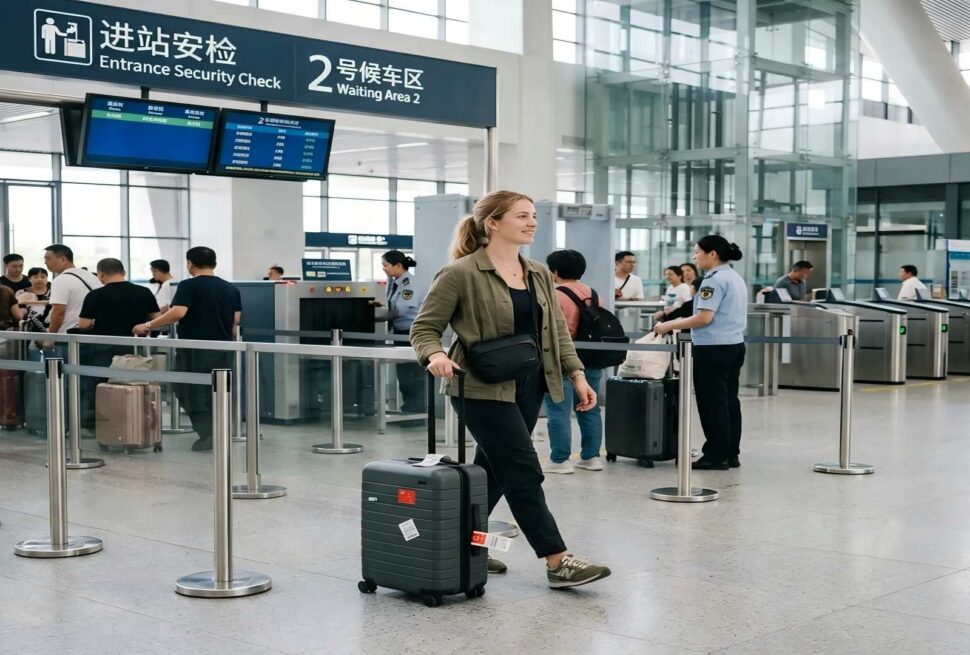
The station process includes identity verification and security screening. Your luggage goes through a scanner, and you need enough time to find the correct waiting area and boarding gate afterward. A first-time traveler should aim to arrive at least 60 minutes before departure, and earlier in large stations or peak holiday periods.
That recommendation is not about exaggerating difficulty. It is about protecting the traveler from unfamiliar friction. If everything goes smoothly, arriving early only costs a little waiting time. If something does not go smoothly, that extra time is what saves the trip.
What Happens at the Station
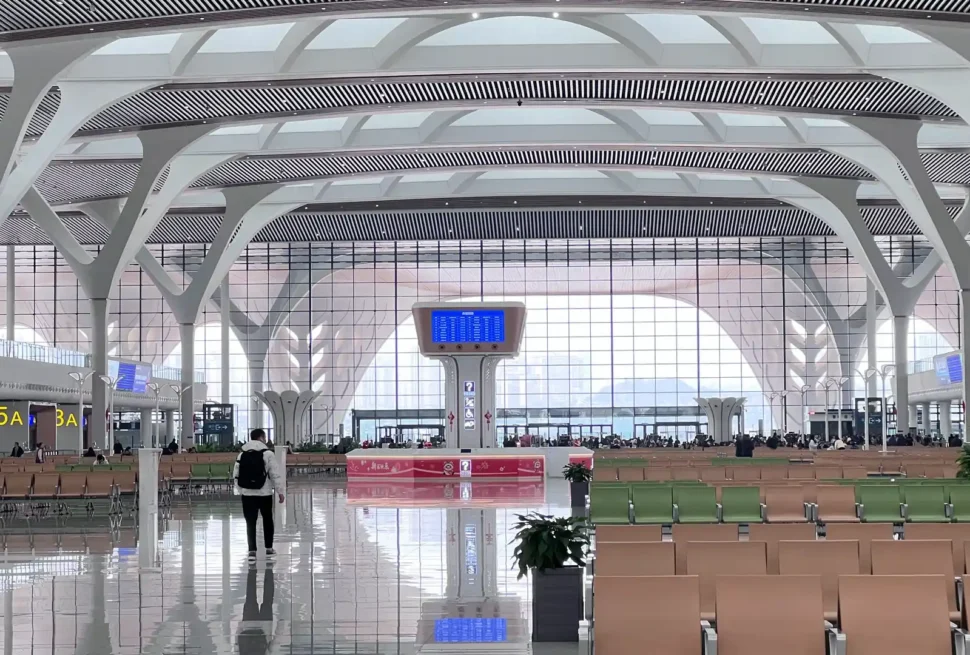
First, you enter the station and complete an identity check using your passport. Then you pass through security screening. After that, you locate the correct waiting area and boarding gate on the station display boards. When boarding begins, the train status shows “Check in” and the gates usually open 10 to 30 minutes before departure, then close shortly before the train leaves.
This is why late arrival is such a risk. Being inside the station does not mean you are effectively safe. You still need enough time to find the right gate, pass the ticket check, reach the platform, and walk to the correct coach.
Once on the platform, the key task is matching your coach correctly. On many high-speed trains, coaches 1 to 8 and 9 to 16 are separated in a way that makes crossing between them impossible. Inside the carriage, seating is straightforward once you know the letter pattern: A and F are usually window seats, C and D are aisle seats, and B is a middle seat where applicable.
Luggage: What Matters in Practice
Luggage rules are one of the areas where first-time travelers often worry too much in the wrong direction.
The official allowance in the source material states that an adult passenger can carry 20 kg, a child 10 kg, and a diplomat 35 kg. For high-speed trains, the theoretical size limit for a single item is 130 cm in combined length, width, and height.
The practical takeaway is not that the rules do not matter. It is that the more important question is whether you can move your own luggage through a station, security line, gate area, and platform without turning every transition into a problem.
On high-speed trains, luggage can usually go in the overhead rack, in storage areas near the ends or joints of coaches, or in extra space behind certain rows depending on the carriage layout.
Do Not Treat Train Security Like Airport Security, but Do Respect It
China train security is usually simpler than airport security, but it is still a real checkpoint. Your bags go through screening, and certain items are prohibited or restricted. The safest approach is practical rather than exhaustive: travel light, avoid carrying questionable items, and do not assume train security is casual just because the journey feels easy.
The Smartest First-Time Mindset
The most useful way to think about China train travel is not as a single action but as a chain of small correct decisions.
Choose the right train type for the route. Check the exact station name, not just the city. Book as early as your schedule allows within the pre-sale window. Keep your passport immediately accessible. Arrive with more time than you think you need. Follow the station sequence calmly. Keep your luggage manageable. Watch the gate status and coach number carefully.
For most first-time travelers, the train itself turns out not to be the stressful part. The uncertainty comes from not knowing which details matter. Once you know those details, China train travel usually feels exactly as it should: fast, structured, and much easier than it looked at first.