Booking a train ticket in China is not usually the hard part. Booking the right one is.
For many first-time foreign travelers, the real risk is not failing to complete the payment. It is paying for a ticket that looks correct at first glance but creates problems later: the wrong railway station, the wrong train type, a departure time that leaves too little margin, or a seat choice that does not fit the trip. These are the mistakes that turn a simple train journey into a stressful travel day.
That is why the smartest way to book train tickets in China is not to start with payment. It is to start with checking what you are actually buying.
Before You Pay: 5 Things to Check
- Check the exact station name.
- Check the train letter and train type.
- Check whether the timing works in real life.
- Check that your passport details match the booking.
- Check whether the seat class fits the journey.
Start With the Booking Rule That Matters Most
If this is your first time taking a train in China, the best booking habit is simple: do not rush from search results to payment.
Foreign travelers can book China train tickets through the official English-language 12306 website using a valid foreign passport. The source material also notes that the usual pre-sale period is 15 days before departure. That means booking is straightforward in principle, but the decision window is not especially long, so it is easy to move too quickly and miss something important.
For a first-time traveler, the goal is not just to get a ticket. The goal is to get a ticket that fits the whole travel day. Before paying, there are several things worth checking in order: whether the station is correct, whether the train type makes sense, whether the timing works in real life, whether the passport details match, and whether the seat class fits the journey.
That order matters. Many booking mistakes happen because travelers focus on price or speed first and only notice the station name or timing later.
Check the Station Name, Not Just the City
This is one of the most important checks for foreign travelers in China.
Many major cities have more than one railway station. A ticket that says Beijing, Shanghai, or Xi’an is not enough in practical travel terms. What matters is the exact departure station and exact arrival station. In China, many station names follow the city + direction format, and the directional part may appear in pinyin rather than in English. For example, Dong means East, Nan means South, Xi means West, and Bei means North.
That is where first-time travelers often make avoidable mistakes. They recognize the city name, assume all stations are interchangeable, and pay without checking the final word. But Beijing South is not the same as Beijing West. Xi’an North is not the same as Xi’an Railway Station. Booking the right city but the wrong station can easily disrupt the entire day.
So before paying, pause and ask one practical question: is this the exact station I want, and can I realistically get there from my hotel or previous stop without stress?
For many travelers, that question matters more than saving a little time on the train itself.
Understand the Train Letter Before You Decide
Another booking mistake comes from assuming every train on the results page is broadly the same.
In China, the train number begins with a letter, and that letter matters. G trains are high-speed EMU trains and are generally the fastest category. D trains are also high-speed trains, but usually slower than G trains. C trains are intercity EMU trains, often used for shorter regional journeys. K, T, and Z are conventional train categories rather than high-speed rail.
For example, if you are booking a major city-to-city route and see a G train at a workable time, that is usually the strongest first option. If the available train is a D train, it may still be perfectly suitable, especially if it serves your station better or fits your schedule more comfortably. On shorter regional routes, a C train may be exactly what you need. But if the results only show K, T, or Z trains, you should recognize that you are no longer choosing among high-speed services and should adjust your expectations accordingly.
A first-time traveler does not need to memorize the whole rail system. But you do need to know enough to avoid booking blindly.
Do Not Choose by Departure Time Alone
A train that looks good on the search page can still be the wrong choice once the rest of the day is considered.
This is especially true for travelers moving between hotels, airports, or multiple cities in one itinerary. The earliest train is not always the best one. The fastest train is not always the most practical one. A cheaper train is not always worth it if it creates an awkward departure from a faraway station or leaves too little buffer before your next connection.
The better booking question is this: does this train make the whole day easier?
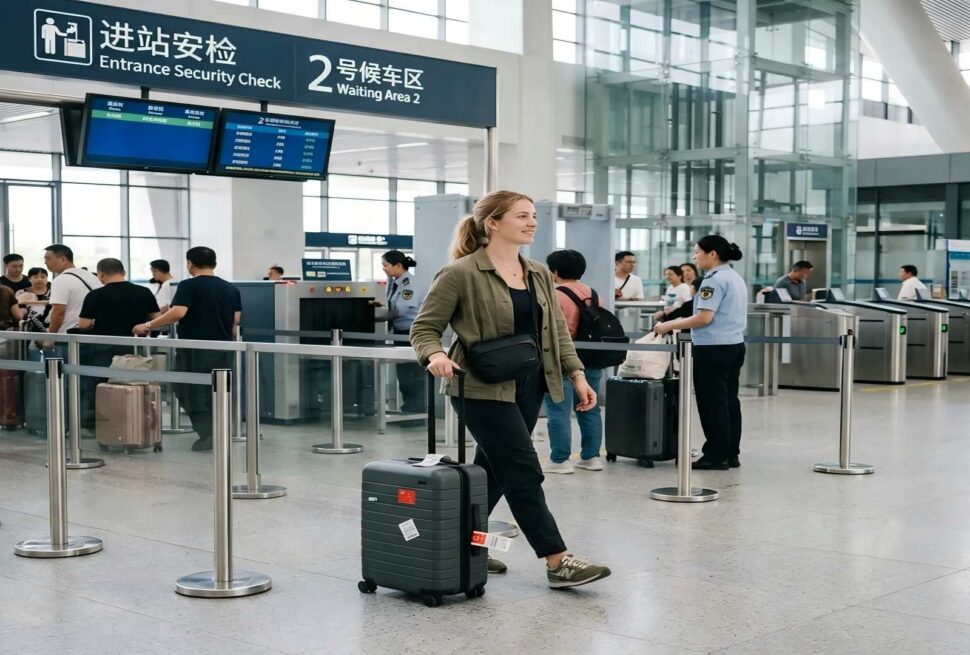
That includes the time needed to get to the station, enter the station, complete identity check and security, find the right waiting area, and board without rushing. For first-time travelers, the source material recommends arriving at least 60 minutes early, and earlier still in large stations or during peak travel periods.
So if a train departure looks efficient on paper but only works if everything goes perfectly, it may not be the right booking for a first trip. A slightly later train with more breathing room is often the smarter choice.
Common Booking Mistakes
- Booking the right city but the wrong station
- Choosing by departure time alone
- Ignoring the train letter
- Entering passport details carelessly
- Paying before checking whether the seat class suits the trip
Make Sure Your Passport Details Match the Booking
Train travel in China uses a real-name ticketing system. For foreign travelers, that means your passport is central to both booking and travel. The English version of 12306 allows foreign passengers with valid passports to register and purchase tickets. During the travel process itself, your passport is also used for identity verification at the station.
That makes accuracy essential. Before paying, check that the passport information entered in the booking is correct and consistent. If the identity details do not match properly, the problem is no longer just administrative. It can interfere with station entry and boarding.
For a first-time traveler, this is one of those checks that feels small when booking and very large when something goes wrong.
Know What Information You Need to Save Immediately
Another common first-time mistake is treating the booking confirmation as something you can look up later without preparation.
Once your ticket is booked, make sure you have the key travel information saved in a form you can access quickly. Useful details include the train number, departure and arrival stations, departure and arrival times, coach number, and seat number. A screenshot or written note is strongly useful.
This matters because the smooth part of train travel begins only after you can recognize your own journey details confidently. At the station, you may need to match your booking to display boards, boarding gates, or platform information quickly. If you do not have your details ready, small moments of confusion can build unnecessary pressure.
Save These Details Immediately
- Train number
- Departure station
- Arrival station
- Departure time
- Arrival time
- Coach number
- Seat number
Choose Seat Class Based on the Journey, Not the Label
Seat class is part of booking, but for first-time travelers it should be treated as a practical decision rather than a status choice.
China train bookings involve different seat classes, and routes may offer different class combinations. On many high-speed services, pricing varies substantially by class.
The right question is not Which class sounds best? It is What does this trip actually need?
For a shorter or straightforward daytime journey, many travelers do not need to overcomplicate the decision. For a longer ride, a more comfortable class may matter more. If you are traveling with family, carrying heavier bags, or simply trying to reduce friction on a first trip, the cheapest available option is not automatically the best value. On the other hand, paying significantly more without any clear comfort need may not improve the journey in a meaningful way.
So before paying, class choice should be tied to route length, timing, who you are traveling with, and how easy or tiring the day will already be. That is a better decision framework than booking by price alone.
Booking Early Helps, but Booking Clearly Helps More
The source material recommends booking as early as possible within the pre-sale window, especially because popular routes and holiday periods can become more competitive. The standard pre-sale period described in the materials is 15 days.
That advice is useful, but first-time travelers should apply it carefully. Early booking is important, but early booking without careful checking is how people lock in the wrong station, the wrong time, or a train that does not actually fit the day.
A better rule is this: book as early as you can after the key details are clear.
That means confirming the right station, the right train category, the right time buffer, the correct passport information, and a seat class that matches the trip.
Once those are in place, payment becomes the easy part.
The Best Booking Habit for a First Trip
If you remember only one thing, remember this: in China, train booking is usually not difficult, but it rewards careful travelers more than fast-clicking travelers.
The strongest first-time booking habit is to slow down for one final review before payment. Check the station name word by word. Check the train letter and number. Check the time in a real-day context, not in isolation. Check the passport details. Check whether the class choice actually suits the journey.
That final pause is what separates a successful booking from a stressful one.
For most foreign travelers, the best China train ticket is not simply the cheapest ticket or the fastest one. It is the one that makes the whole trip smoother from hotel departure to station arrival to boarding.
Related Reading
Still planning your first train trip in China? Read the full guide series before you book.