For first-time travelers in China, luggage is one of the easiest things to underestimate.
Many visitors assume train luggage will be effortless because rail travel feels simpler than flying. In some ways, that is true. China train travel is usually more forgiving than air travel when it comes to carrying bags with you. But that does not mean luggage is something to treat casually. The real issue is not only whether your bag is technically allowed. It is whether your luggage still feels manageable when you are carrying it through a busy station, lifting it onto a scanner, moving through a boarding gate, and getting it onto the train without turning every step into a problem.
That is why the most useful way to think about luggage on China trains is not just in terms of rules. It is in terms of friction. Some bags are easy to travel with. Some bags are technically possible but make the journey harder than it needs to be. And some items are simply not worth trying to bring at all.
Quick Answer: Pack for Movement, Not Just Storage
- Bring luggage you can move, lift, scan, and store by yourself.
- One suitcase plus one small personal bag usually works best.
- Do not treat train luggage rules as unlimited.
- Avoid questionable, oversized, or awkward items.
- Keep passport, phone, medication, and valuables in a small bag.
Train Travel Is More Forgiving Than Flying, but Not Unlimited
China train travel usually allows passengers to carry personal luggage onto the train without the kind of check-in baggage routine most travelers associate with airports. That is one reason trains feel practical and convenient, especially for short and medium-distance travel. The source material notes that ordinary tourist luggage is often handled with more flexibility in practice than the official rules might suggest, as long as it is not obviously oversized, excessive, or difficult to manage.
That sounds reassuring, but first-time travelers should not interpret it too loosely. “More forgiving” does not mean “anything goes.” You still need to pass security, move through the station yourself, and place your luggage somewhere appropriate once onboard. If a suitcase is too large, too heavy, too awkward, or too numerous, it may become a practical problem even before it becomes a rule problem.
So the best luggage mindset for a first trip is simple: travel lighter than the train technically allows, not heavier.
Know the Official Allowance, but Use Common Sense First
The source material states that the standard free carry-on allowance is generally 20 kg for each adult passenger, 10 kg for each child, and 35 kg for each diplomat. For high-speed trains, the theoretical size limit for each piece is generally 130 cm in total length, width, and height. For conventional trains, the total can be larger. Rod-shaped items can be longer under the stated rule set.
Those numbers are useful, but for first-time travelers the more practical question is not “Can I reach the maximum?” It is “Can I handle this bag myself, quickly and without stress?”
A suitcase that is technically acceptable can still be a bad choice if it is hard to lift, hard to scan, hard to roll through crowds, or hard to store once you board. This matters even more if you are traveling alone, changing cities often, or arriving at a large station for the first time.
In other words, the formal allowance gives you the outer limit. It should not automatically become your packing target.
20 kg
adult passenger allowance
130 cm
combined size for high-speed trains
1 suitcase + 1 small bag
most practical first-trip setup
The Easiest Packing Rule: Bring What You Can Move Independently
If you cannot move it smoothly by yourself, it may become a problem before you even board.
If you can move your luggage independently through the whole station process, you are probably in a good position. If you already suspect that you will need help lifting it, dragging it, or reorganizing it in public, the issue is no longer only about policy. It is about how tiring the day will become.
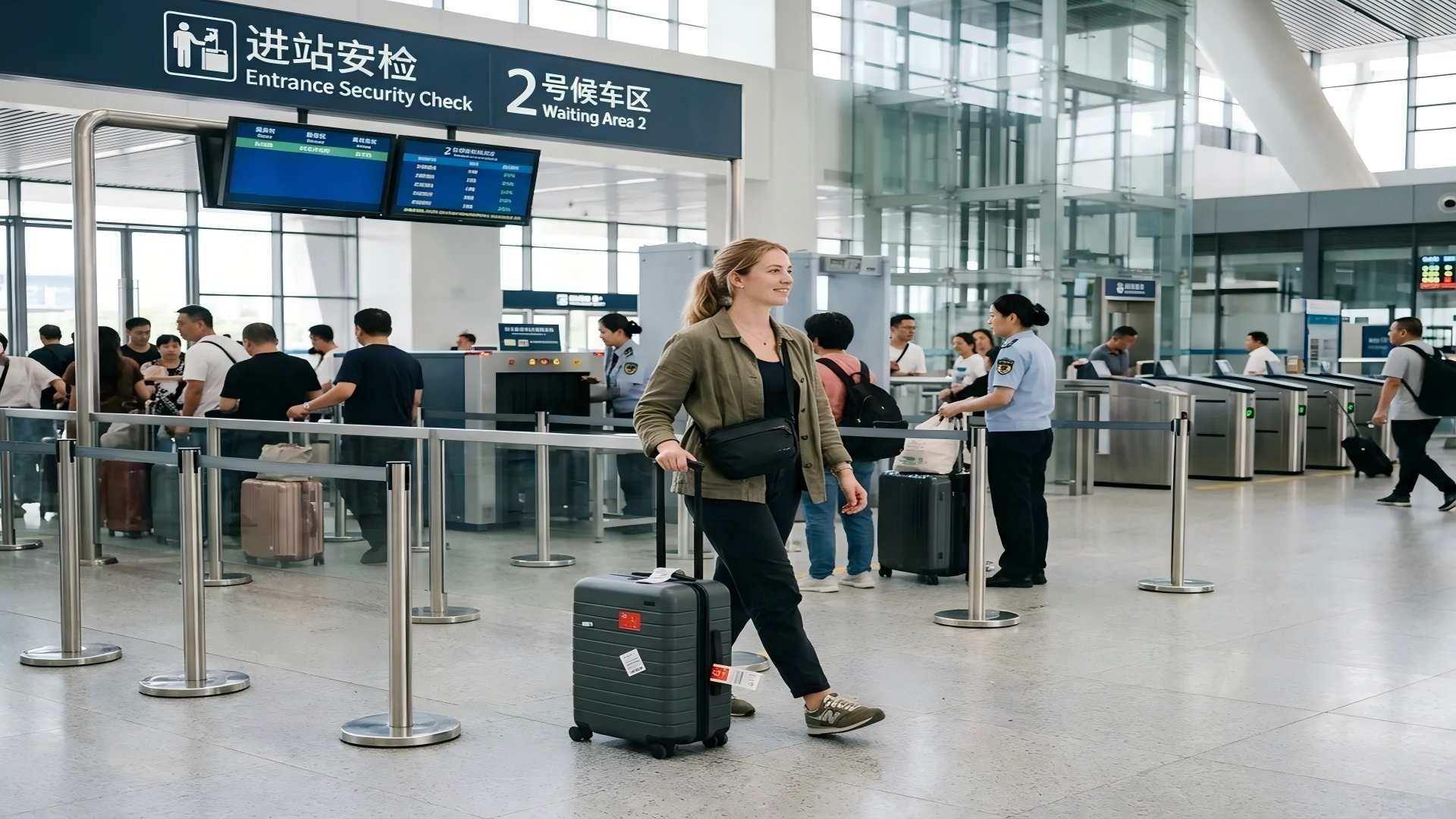
That matters because China train stations usually involve more movement than first-time visitors expect. Even before boarding, you may need to walk into the station, present your passport, put your luggage through security screening, move to the waiting area, go down to the platform, find the right coach, and then place the bag somewhere once onboard.
A suitcase that feels acceptable in a hotel room can feel very different in that sequence.
What Usually Works Well on China Trains
Best Setup for First-Time Travelers
- One suitcase you can lift yourself
- One small personal bag
- Passport and essentials kept within reach
- No loose shopping bags or awkward boxes
- No last-minute repacking at the station
For most first-time travelers, the least stressful setup is simple and manageable: one suitcase that you can lift yourself, plus one smaller personal bag that stays with you.
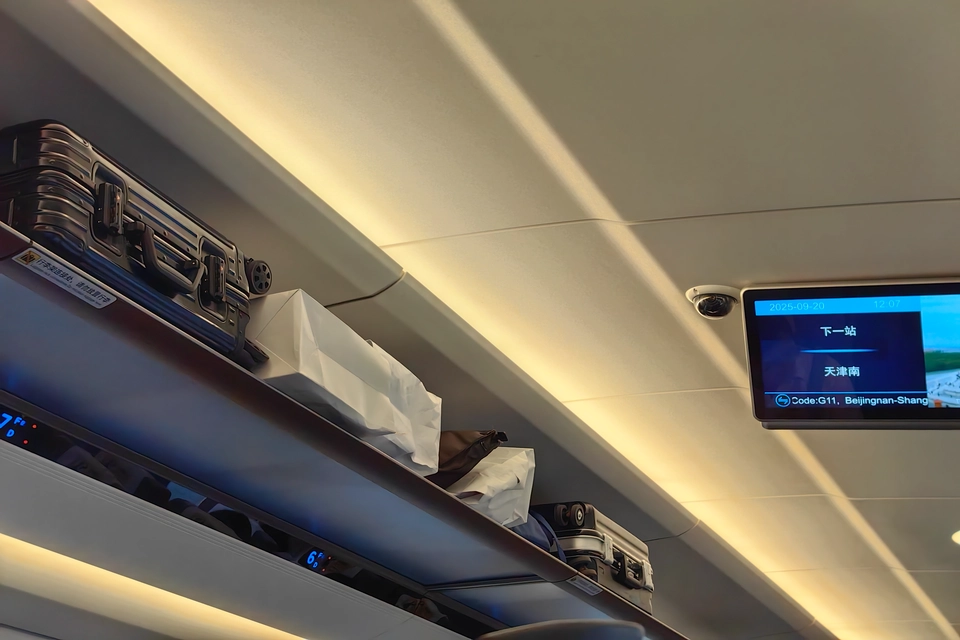
This kind of arrangement tends to work well because it fits the way train travel actually moves. You can pass security more easily, keep your passport and essentials accessible, and store your belongings without much trouble once you board. The source material notes that luggage can usually be placed in the overhead rack or under the seat, and on high-speed trains there are also larger storage areas near the ends of coaches or behind the last row in some carriages.
The smaller your number of loose items, the easier the whole process becomes. A first-time traveler with one main suitcase and one day bag usually has a much smoother station experience than someone traveling with multiple shopping bags, extra boxes, and a large case that barely rolls straight.
What Causes Problems Even When It Is Not Strictly Forbidden
The most troublesome luggage is often not forbidden luggage. It is awkward luggage.
That includes oversized suitcases, too many separate bags, items that are difficult to stack or keep together, and luggage that takes too long to move on and off the train. Even if such items are not stopped immediately at security, they can still slow you down at every stage of the journey.
This becomes especially relevant on a first trip because unfamiliar stations make ordinary physical tasks feel heavier. A bag that is just manageable in your home airport may feel much less manageable if you are also trying to identify a boarding gate, read platform signs, or find the right coach.
So the best question is not “Will they let me bring this?” It is “Will I regret bringing this by the time I reach my seat?”
The real question is not only “Will they allow it?” but “Will I regret bringing it?”
Prohibited and Restricted Items
There are some categories of items that first-time travelers should simply not gamble on.
According to the source material, prohibited items include weapons and weapon-like objects, many knives and sharp tools, live animals other than qualified guide dogs, explosives, fireworks, compressed gases, flammable liquids, poisons, corrosive materials, radioactive materials, infectious materials, and other dangerous goods. Magnetized items are also listed among prohibited categories in the source text.
This is not an area where a traveler should rely on optimism. If an item is obviously risky, dangerous, or questionable, it is better not to pack it at all. Train security is simpler than airport security in some ways, but it is still a real screening process, and prohibited items can stop your trip before it begins.
For first-time travelers, the safest rule is straightforward: if you would hesitate before putting it through security, do not bring it.
Do Not Gamble With These Items
- Weapons or weapon-like objects
- Dangerous knives or sharp tools
- Explosives, fireworks, compressed gases
- Flammable, poisonous, corrosive, radioactive, or infectious materials
- Questionable items you would hesitate to put through security
Restricted Items Are Where Travelers Make More Small Mistakes
The more realistic problem for many international travelers is not carrying something obviously dangerous. It is carrying something that seems ordinary but is quantity-restricted.
The source material lists several examples. Alcoholic drinks with intact packaging and clear labeling may be allowed only within a specific alcohol range and total volume. Some daily-use products with flammable components, such as certain sprays or similar items, are limited by container size and quantity. Nail polish and remover are also limited. Self-pressurized containers such as hair spray, mousse, air freshener, and some insecticide or sunscreen sprays are subject to capacity limits. Safety matches and ordinary lighters are also limited in number. Clearly labeled power banks and lithium batteries are allowed only up to a stated energy limit.
These are the kinds of details that catch travelers off guard because they involve everyday items rather than obviously dangerous ones.
The practical lesson is not that every toiletry item is a problem. It is that train travel still has a security logic, and first-time travelers should pack toiletries and portable electronics with some restraint instead of assuming trains have no meaningful restrictions.
Power Banks and Small Personal Items Still Deserve Attention
Travelers often focus on large luggage and forget that small personal items can be the ones that trigger unnecessary problems.
The source material specifically mentions clearly labeled power banks and lithium batteries within a stated energy threshold. That means electronics are not ignored simply because they are common. For a first-time traveler, the safest approach is to bring ordinary, clearly labeled personal devices and avoid unusual battery items or anything that looks improvised.
The same principle applies to travel-size liquids, sprays, and small self-pressurized products. A few normal, clearly packaged items are one thing. A cluttered toiletries bag filled with borderline items is another.
Where Your Luggage Goes Once You Board
Keep These in Your Small Bag
- Passport
- Phone
- Charger / power bank
- Medication
- Wallet and valuables
- Train details or screenshot
Common luggage storage areas:
- Overhead rack
- Under the seat
- Storage areas near the ends of coaches
- Extra space behind certain rows, depending on carriage layout
The stress of luggage does not end when you get through security. It follows you onto the train.
The source material notes that on China trains, luggage can usually be stored in the overhead compartment or under the seat. On high-speed trains, larger luggage may also go in extra storage spaces near the ends of coaches or behind the last row. Small bags and valuable personal items are better kept with you rather than placed far away.
This matters because storage is one of the main reasons to pack realistically. If a bag is too large or heavy for an overhead rack and too awkward for the dedicated luggage area, then even a technically permitted bag can become inconvenient in real travel conditions.
For first-time travelers, it is usually wise to keep passports, phones, chargers, medication, and daily valuables in a smaller personal bag rather than in the main suitcase. That way, even if the larger case is stored away from your seat, the essentials stay with you.
High-Speed Trains Are Not the Place for “I’ll Just Check It”
One detail that matters more than some travelers expect is that high-speed trains generally do not function like flights when it comes to baggage handling. The source material notes that high-speed trains do not have specialized baggage cars for ordinary checked luggage service in the normal passenger sense.
That changes the packing logic. You should not plan your trip around the assumption that oversized or inconvenient luggage will simply disappear into a system and reappear later. On most first-time tourist journeys, the luggage you bring is the luggage you need to handle yourself.
This is another reason why “technically possible” is not the right standard. “Easy to carry through the whole day” is much more useful.
On most first-time tourist journeys, the luggage you bring is the luggage you need to handle yourself.
What First-Time Travelers Usually Get Right
The travelers who tend to have the smoothest train days in China are not necessarily the lightest packers in absolute terms. They are the most realistic ones.
They bring luggage they can control. They avoid questionable items. They keep their essentials accessible. They do not rely on last-minute repacking in the station. And they do not assume train travel means rules disappear.
For a first trip, a simple and sensible luggage setup usually works better than a maximal one. That is true even if the official allowance seems generous.
The Best Luggage Rule for a First China Train Trip
If there is one rule worth remembering, it is this: pack for movement, not just for storage.
A China train trip is not only about what fits inside your suitcase. It is about how easily that suitcase moves through the whole journey. If you can carry it, scan it, wheel it, store it, and collect it without stress, you are probably packed well. If not, the problem starts long before the train leaves the station.
For most first-time travelers, the smartest luggage choice is not the largest bag the policy might allow. It is the one that makes the station, the boarding process, and the train itself feel easier from beginning to end.