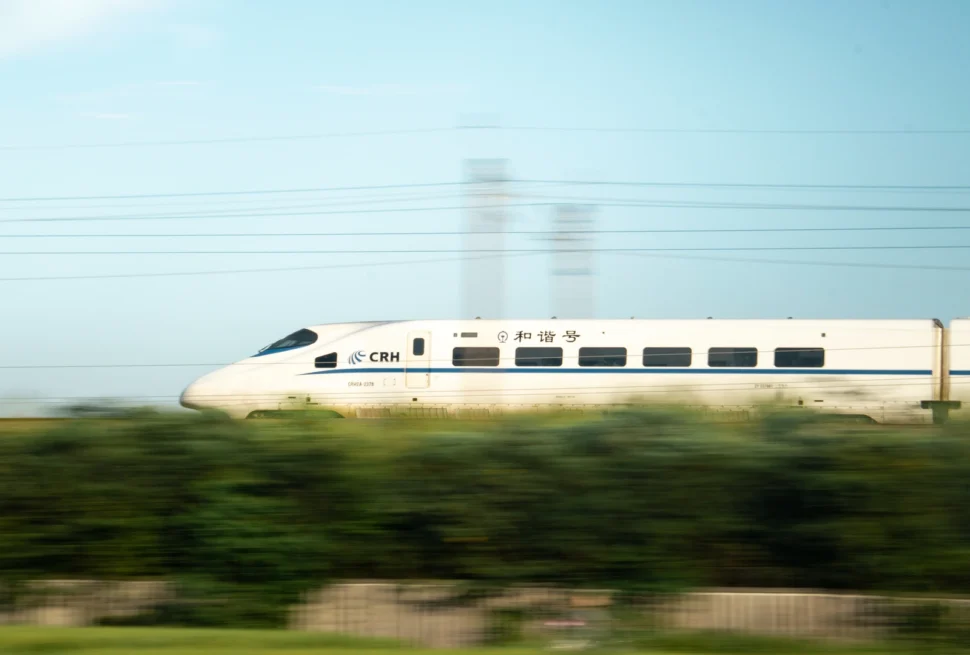
For many first-time travelers in China, the train ride is not the part that feels uncertain. The station is.
That makes sense. Before the first trip, most visitors are not wondering whether the train itself will be comfortable. They are wondering what happens between the station entrance and the moment they finally sit down. Will the process feel confusing? Will the signs be hard to follow? How early do they need to arrive? What if they go to the right city but the wrong station? What if they get through security and still cannot find the gate in time?
The reassuring part is that China train stations usually follow a clear sequence. The stressful part is that if you do not know that sequence in advance, the station can feel much bigger and faster-moving than it really is.The easiest way to think about a China train station is not as one big unknown place. It is a series of small steps: arrive at the correct station, pass identity check, go through security, find the right waiting area, watch for boarding, go down to the platform, find the correct coach, and then find your seat. Once you understand that flow, the station becomes much easier to handle.
Station Flow at a Glance
- Arrive at the correct station
- Complete passport / identity check
- Pass security screening
- Find the waiting area
- Watch for “Check in”
- Go to the platform
- Find the correct coach
- Find your seat
On this page
The First Risk Is Often Before You Enter the Station
For first-time travelers, one of the most common mistakes happens before the station process even begins: going to the wrong station.
Many major Chinese cities have more than one railway station. A booking for Beijing South is not interchangeable with Beijing West. Xi’an North is not the same as Xi’an Railway Station. China train station names often follow the “city + direction” pattern, and those direction words may appear in pinyin rather than in English. Dong means East, Nan means South, Xi means West, and Bei means North.
That matters because even if everything else goes smoothly, arriving at the wrong station can ruin the day. So before you think about station procedures, make sure you have checked the exact station name, not just the city.
This is also why first-time travelers should save their train details in a form that is easy to open quickly. Your train number, departure station, departure time, coach number, and seat number should not be something you have to search for under pressure. A screenshot or saved note makes the whole station experience easier from the start.
Arrive Earlier Than the Ride Seems to Require
One of the most practical first-trip habits is arriving earlier than the train journey itself may seem to justify.
The source material recommends reaching the station at least 60 minutes before departure if it is your first time. In large stations such as Beijing, Shanghai, or Xi’an, it recommends arriving about 1.5 hours early, or even 2 hours early during especially busy travel periods such as major public holidays.
This is not because the train system is badly organized. It is because large stations involve several separate steps, and first-time travelers almost always move through them more slowly than experienced passengers. You may need extra time to confirm the entrance, pass the passport check, understand the layout, locate your waiting area, and recognize when your gate starts boarding.
In other words, the extra time is not wasted time. It is what turns the station from stressful into manageable.
60
min early (first visit)
90
min for large stations
3–8
min before gate closes
Station Tip: The easiest way to think about a China train station is not as one big unknown place — it is a series of small steps.
What Happens at the Entrance
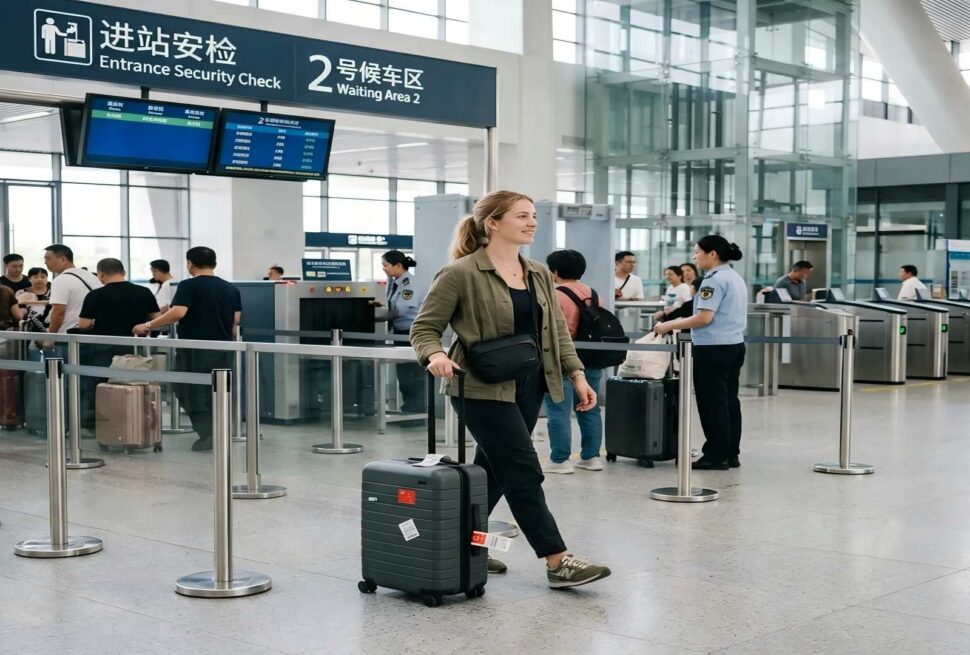
At the station entrance, you should expect identity verification before anything else.
China train travel operates under a real-name system, and for foreign travelers the passport is central to that process. At many major stations, you scan your passport at the entrance and the system verifies your identity, often by matching your face to the passport record. If the station is smaller or the machine does not work smoothly, there is usually a manual check point where staff can assist.
This means your passport should be immediately accessible, not buried deep inside your luggage. It also means that station entry is not something to leave until the last minute. Even before security, there is already a meaningful step to complete.
For a first-time traveler, the best mindset here is simple: have your passport ready, have your train details ready, and expect a short but real checkpoint before you are inside the station proper.
Security Comes Early in the Process
After identity verification, the next stage is security screening.
In practice, this works in a way that most travelers will recognize. Your luggage goes onto the scanner, and you walk through a metal detector. You usually do not need the same level of unpacking as airport security, but it is still a real screening process and should be treated that way. Staff may also use a handheld device for an additional body check if needed.
This is one reason large or awkward luggage can make a first station experience more tiring than expected. High-speed train luggage rules are generally more forgiving than airline rules, but manageable luggage still matters because you need to lift, move, scan, and carry it through a crowded station. Adult passengers are generally allowed 20 kg of carry-on luggage, and on high-speed trains a single piece is generally expected not to exceed 130 cm in total length, width, and height.
There is also a practical safety point here. Prohibited and restricted items are taken seriously. Dangerous goods, offensive weapons, and many hazardous or flammable items are not allowed. Some items such as matches, lighters, sprays, and certain liquids may be restricted by quantity.
For first-time travelers, the best approach is not to memorize every rule in detail while standing in line. It is to avoid bringing questionable items at all.
Once You Are Inside, the Station Starts to Make More Sense
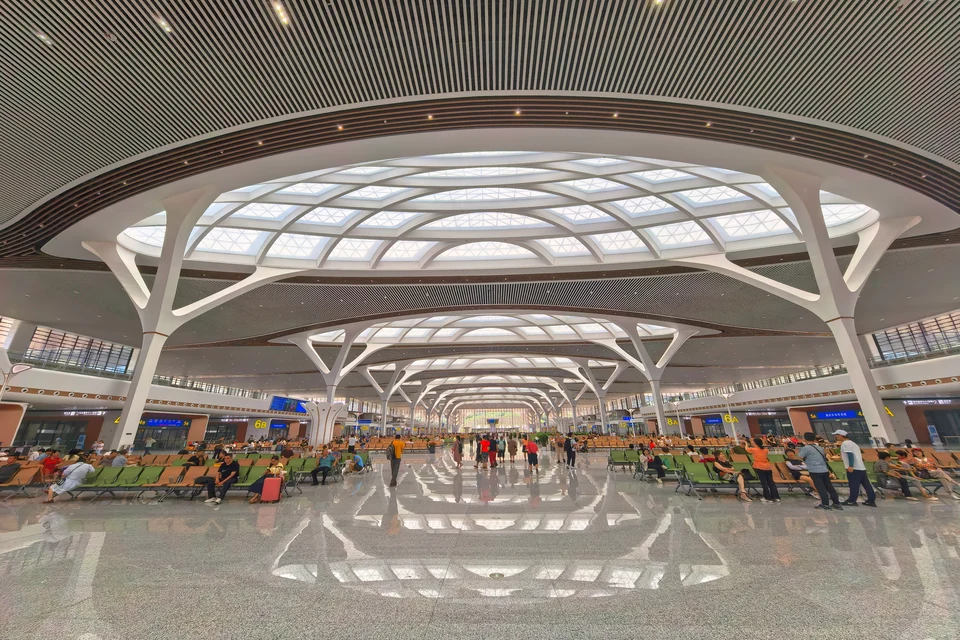
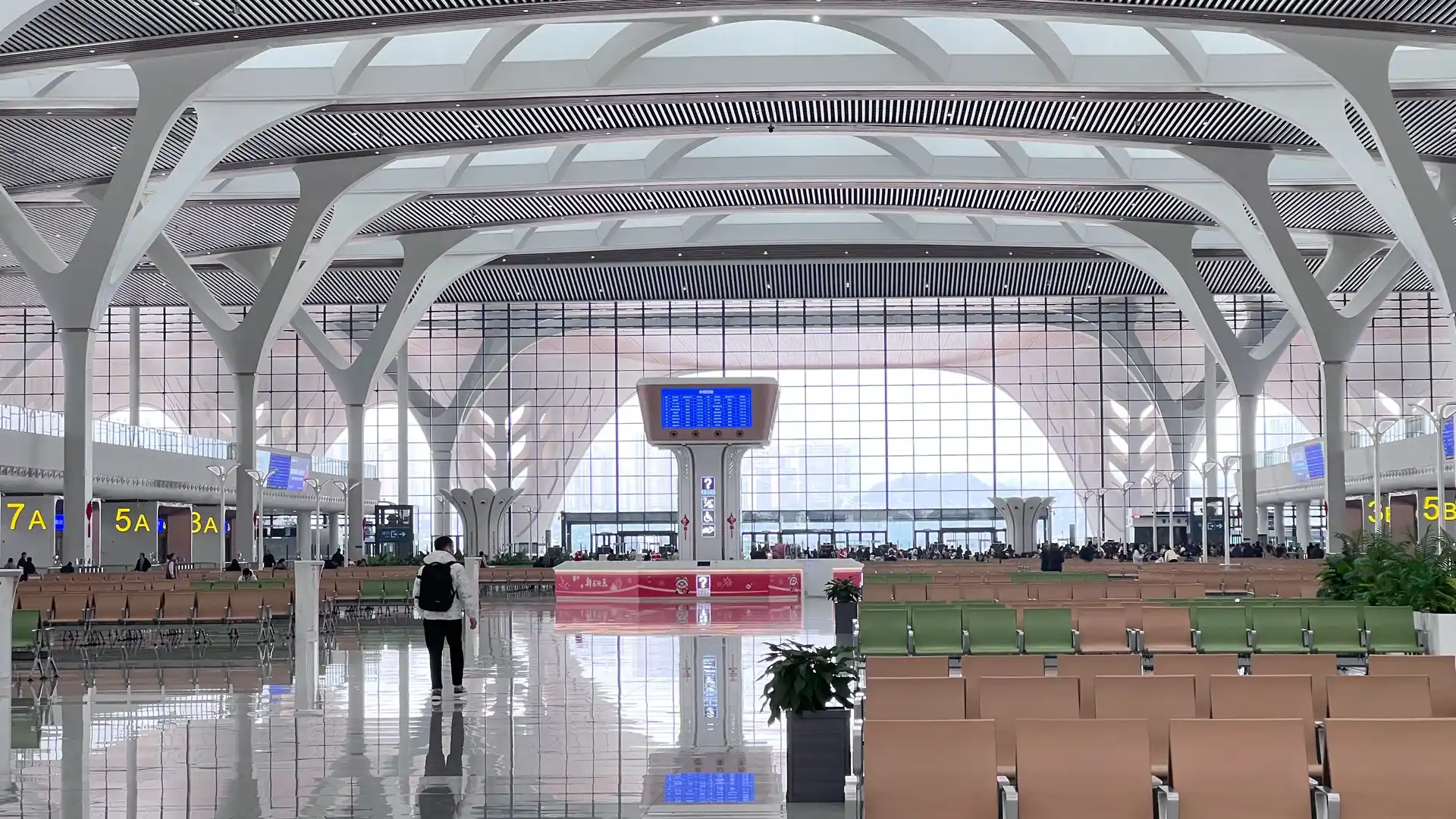
After security, many first-time travelers feel a second wave of uncertainty because the station opens up into a larger waiting area. This is the moment when the station can either feel organized or overwhelming.
The practical key is not to read everything. It is to locate the station display boards and match your own train information to them. In larger stations, the LED display boards typically alternate between Chinese and English. Smaller stations may show less English, but your train number and departure time are still the easiest anchors to follow.
This is where having your details saved matters again. You do not need to understand every sign in the station. You need to identify your train number, your departure time, and your boarding gate or waiting area.
If your printed or digital ticket does not already show a boarding gate, the station display board is where you should check it. Some tickets include gate information, but not all do, so the screen remains the most reliable station reference once you are inside.
The Waiting Area Is Part of the Process, Not a Delay
At this point, you usually move to the designated waiting area for your train.
First-time travelers sometimes feel anxious if they are not moving toward the platform immediately, but in most cases that is exactly how the station is meant to work. The waiting area is where you stay until the train opens for boarding. The key is not to wander too far and not to assume boarding has started just because the departure time is getting closer.
On the station display, your train status will usually change to “Check in” (正在检票) when boarding begins. According to the source material, this usually happens around 10 to 30 minutes before departure. Staff may also make announcements over the station PA system.
This is the moment when the process becomes faster again, so the safest habit is to stay reasonably close to your gate once your train is approaching boarding time.
Boarding Starts Earlier Than Some Travelers Expect, and Stops Earlier Too
Important: Departure Time Is Not the Only Deadline
- Be near the gate before boarding begins.
- Watch for the “Check in” status.
- Do not assume you can board until the exact departure time.
- The gate may close before the train leaves.
One of the most important details for first-time travelers is that boarding does not remain open until departure.
The source material notes that the gate typically closes around 3 to 8 minutes before departure, after which the train status changes to “Stop Checking” (停止检票).
This is exactly why arriving late is risky even if the train has not left yet. By the time a first-time traveler is hurrying through the station, the real deadline may already have passed.
So the better way to think about your train time is not “the train leaves at 10:00.” It is “I need to be at the gate and ready before boarding closes.” That is a much more useful mental deadline.
Getting to the Platform Is Usually Simple Once the Gate Opens
After ticket check, the next step is reaching the platform.
In many large high-speed rail stations, the platform is directly below the boarding gate, and passengers go down by stairs, escalator, or elevator. In some smaller stations, the platform may be on the same level and the transition is even simpler. Either way, once you are past the gate, the route to the platform is usually clearly marked.
The platform is also where first-time travelers often start to rush unnecessarily. In reality, this step is easier if you slow down just enough to read the coach signs and orient yourself properly.
Finding the Right Coach Matters More Than Boarding Fast
Many high-speed trains have 8 to 16 coaches, and the platform signage is designed to help you locate the right one. This is where coach number becomes more important than simply getting onto the train quickly.
A particularly useful detail from the source material is that on many high-speed trains, coaches 1 to 8 and 9 to 16 are separated, and passengers cannot move across that division between coaches 8 and 9. That means boarding the wrong section can create an avoidable problem, especially if time is tight. If your seat is in coach 4, boarding through coach 9 is not a clever shortcut. It may leave you unable to reach your seat from inside the train.
For first-time travelers, this is one of the best examples of how China train stations reward calm attention rather than speed. Boarding slightly later through the correct section is usually better than boarding quickly through the wrong one.
Coach Tip
- Check your coach number before boarding.
- Do not board quickly through a random door.
- Coaches 1–8 and 9–16 may not always connect inside the train.
- Boarding through the correct coach section is better than rushing.
Finding Your Seat Is Usually the Easiest Part
Once you are inside the train, the hardest part is usually over.
Seat numbers are shown above the rows, and the letter layout is straightforward once you know it. In standard high-speed seating, A and F are window seats, C and D are aisle seats, and B is the middle seat in the three-seat block.
- A / F: window seats
- C / D: aisle seats
- B: middle seat where applicable
Larger luggage can go in the overhead rack or in the luggage storage areas near the ends or joints of the coaches. Some high-speed trains also have extra luggage space behind the first or last row depending on the carriage layout.
The practical point is that if you have reached your coach with the right passport, the right train details, and manageable luggage, the last step is usually simple.
The Exit Side of the Journey Is Easier, but Still Worth Expecting
Although this article is about station entry to boarding, first-time travelers often feel more confident if they also know what happens at the other end.
If your destination is not the terminus, the source material notes that stop announcements usually come about 10 minutes before arrival, giving passengers time to prepare. In smaller stations, stops may be very brief, sometimes only 2 to 3 minutes, so collecting luggage early is wise. After getting off, clear overhead signs usually lead you toward the exit, and in many cases passport-based exit checking is part of the process before you fully leave the station.
That matters because the full station experience does not really end at boarding. It ends when you know how to get off smoothly too.
What First-Time Travelers Usually Need Most
The most useful thing to remember is that a China train station is not difficult because it is chaotic. It can feel difficult because it moves in a sequence you may not know yet.
Once that sequence is clear, the whole experience becomes much more manageable. Before your first train trip in China, the most important habits are simple:
- Go to the exact station.
- Arrive earlier than you think you need to.
- Keep your passport and train details ready.
- Follow the identity check and security flow.
- Use the LED boards to confirm your gate.
- Watch for “Check in.”
- Go to the platform calmly.
- Board through the correct coach section.
- Find your seat without rushing.
For most first-time travelers, the station becomes easier much faster than expected. The biggest difference is not language fluency or prior rail experience. It is simply knowing what to expect before you walk in.